
The Real Cost of Data Platform Technical Debt - and How to Fix It
Introduction: The Invisible Crisis
Picture a senior data engineer staring at a transformation script - three nested CASE statements, cryptic column names, no comments.
“Do we still need this? What breaks if I change it? Who do I even ask?”
That quiet moment of uncertainty is the hallmark of data platform technical debt - a form of debt more insidious than in traditional software engineering. While software code tends to fail fast and visibly, data pipelines often limp along producing almost correct results, silently eroding trust and decision-making.
Technical debt is hardly new - 91% of CTOs list it among their top concerns - but in data platforms, it behaves differently. It compounds quietly, invisibly, and across systems few people fully understand. This post examines why that happens, what it costs, and how to systematically address it.
Part 1: Understanding the Debt - It’s Not What You Think
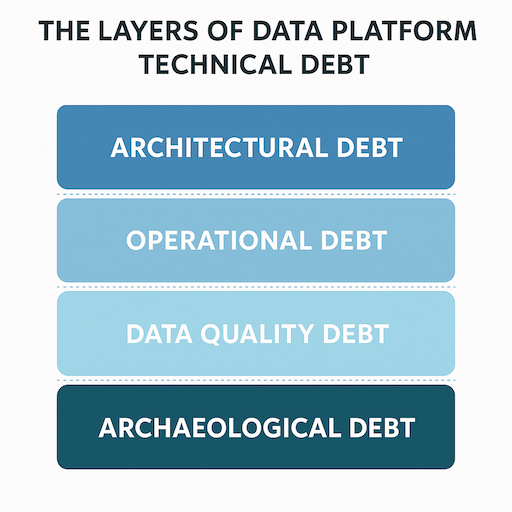
The Three Types of Data Platform Debt
1. Architectural Debt - The Structural Missteps
When fundamental design decisions lag behind business needs:
Monolithic pipelines instead of modular components
Batch jobs when streaming is required
Tightly coupled systems where every change ripples outward
“We’ll migrate to new technology X and fix everything” wishful thinking
Key insight: Migration without remediation doesn’t erase the debt - it merely relocates it.
2. Operational Debt - The “We’ll Do It Later” Tax
The small postponements that quietly accumulate:
“We’ll add monitoring next sprint.”
“We’ll document once it’s stable.”
“We’ll add alerts after launch.”
Each decision saves an hour now and costs days later. The real danger isn’t immediate failure - it’s that mean time to recovery (MTTR) explodes when something breaks, because only one engineer still understands how it works.
3. Data Quality Debt - Accuracy That Decays Over Time
Unique to data systems, this form of debt grows through:
Backward-incompatible schema changes
Skipped validations
“Good enough for now” transformations
A 95% accurate pipeline across three layers compounds to only 85% overall. Unlike code bugs, data issues rarely trigger loud failures - they quietly propagate.
Archaeological Debt: The Hidden Fourth Type
Some transformations exist, run daily, and no one remembers why.
Why does that .fillna(0) exist?
Why are there three extra join conditions?
Who requested that filter five years ago?
Every such mystery creates paralysis. A simple two-hour change becomes a two-week archaeological dig. Teams build around unclear logic rather than resolving it, and before long, 40% of engineering time is spent just figuring out what’s safe to touch.
Part 2: The Real Costs (That Nobody Measures)
Opportunity Cost - The Invisible Killer
How many analytics use cases never launch because the platform can’t support them?
How many ML models remain ideas because the feature layer is too brittle?
Innovation doesn’t stop for lack of ideas - it stops for lack of foundation.
Cognitive Load - The Retention Risk
Senior engineers spend 60% of their time explaining “why things work this way.”
New hires take six months to become productive.
Knowledge lives in people, not systems. When those people leave, so does the platform’s memory.
Trust Erosion - The Birth of Shadow IT
When business users stop trusting the official data platform, they build Excel models and personal databases. Fragmentation follows. Data governance becomes impossible, and technical debt metastasizes into organizational debt.
Decision Latency - The Hidden Business Cost
Lengthy meetings to confirm whether numbers are “right.”
Stakeholders waiting on the data team to “investigate.”
Each instance of doubt delays decisions and corrodes confidence.
The Compound Interest Effect
Data debt doesn’t just accumulate- it multiplies.
More teams mean more consumers, more exceptions, more brittle workarounds.
Unlike financial debt with predictable interest, data debt compounds at an accelerating, opaque rate.
Part 3: The Investigation Dilemma
What Actually Needs to Be Known
A data engineer doesn’t need code that merely says:
WHERE status != 'cancelled'They need to know:
The business rule (“Finance tracks cancelled orders separately”)
The failure mode (“Otherwise, revenue is double-counted”)
The decision history (“Fixing it upstream wasn’t feasible”)
The stakeholder (“Requested by Finance in Q3 2023”)
That’s the context missing from most transformations - and the root of investigation debt.
Why Traditional Documentation Fails
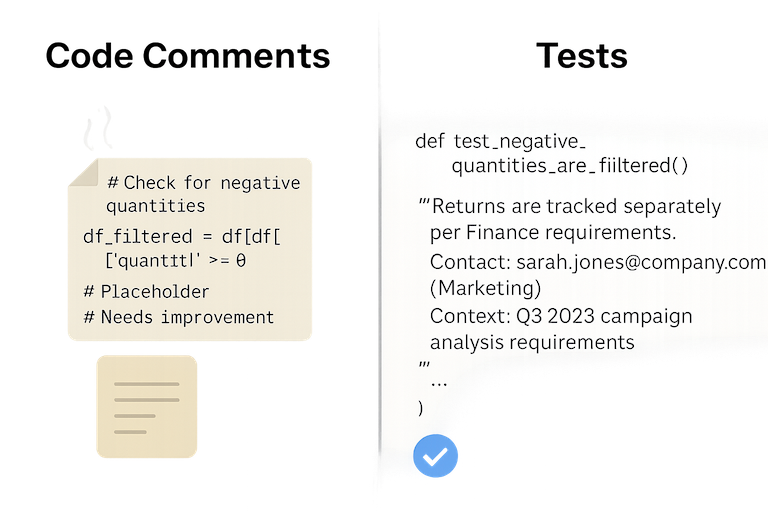
Code Comments
Explain what, not why
Go stale after five commits
Rarely capture business rationale
External Docs (Confluence, README)
Not where developers look
Age instantly
Lose context and ownership
What Actually Works: Tests as Documentation
def test_negative_quantities_are_filtered():
    """Finance requires returns tracked separately.
    Contact: sarah.jones@company.com
    Context: Q3 2023 campaign analysis
    Created: 2023-08-15 | Last Reviewed: 2024-11-01"""
Benefits:
Executable documentation that can’t silently decay
Embeds context where engineers already look
Enables safe refactoring and regression prevention
Most data pipelines lack this entirely.
The Investigation Tax - A Decision Framework
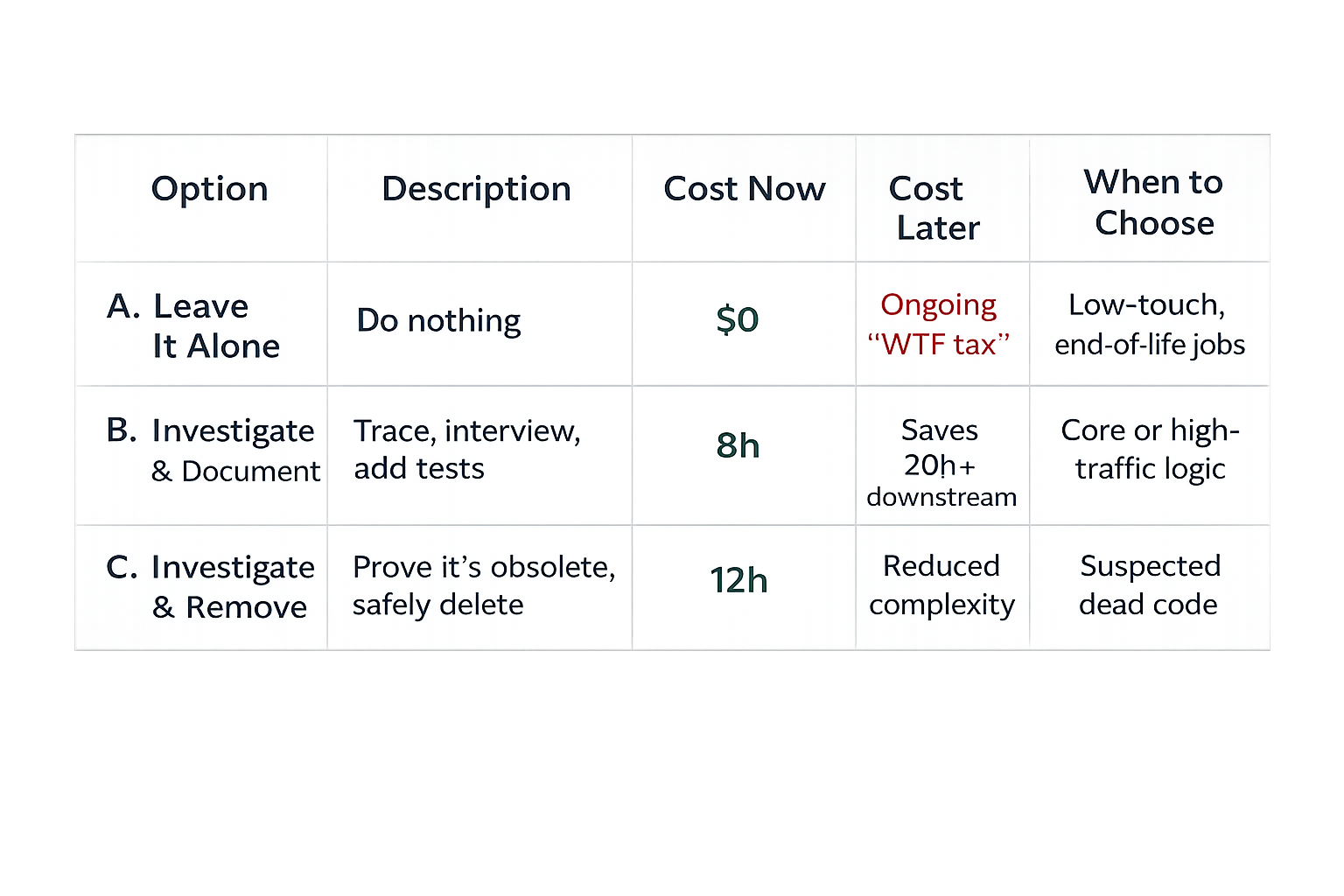
If ten developers touch an undocumented transformation twice a year, Option B quickly becomes cheaper.
Practical Approach
Start with lineage and impact analysis - know what’s downstream before changing anything.
Time-box the archaeology - two hours maximum, then move forward.
Use monitoring as insurance - let production validate your assumptions.
Record what you learn - even “investigated on [date]; still needed for X” prevents future confusion.
Part 4: Systematic Solutions
Prevention - Stop Creating New Debt
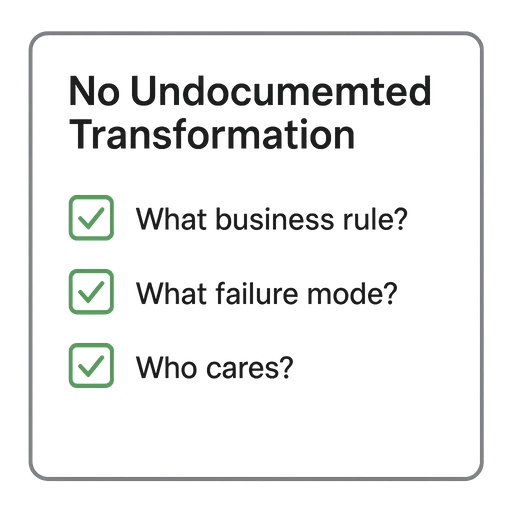
The “No Undocumented Transformation” Standard
Every transformation must specify: business rule, failure mode, owner.
Enforce via pull-request templates and code review.
Make creating debt harder than fixing it.
Transformation Expiration Dates
Tag logic with: “Created for [business need], review by [date].”
Forces periodic “does this still matter?” reviews.
Design Patterns That Resist Debt
Modular, testable components over monoliths
Schema contracts between producers and consumers
Explicit error handling, not silent failure
Configuration over hard-coded logic
Tax the Debt
“You break it, you fix it” accountability
New features must include tests
Schema changes require backward-compatibility review
Remediation - Tackling Existing Mysteries
The Transformation Registry
A simple spreadsheet or metadata table:
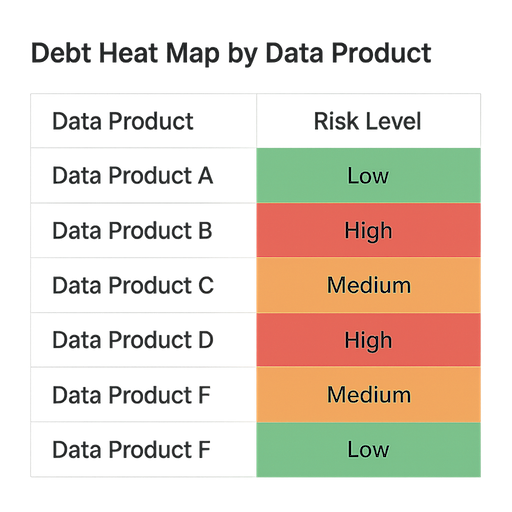
Transformation Name | Business Purpose | Owner | Last Validated | Risk Level | Removal Candidate?
This creates a heat map of where the debt concentrates and prioritizes investigation.
Quarantine Strategy
Identify high-value data products
Ring-fence them with contracts, tests, and monitoring
Let low-value pipelines fade naturally
Rebuild vs. Investigate Decision
Investigate when:
High downstream dependencies
Sensitive or regulated data
Core logic with known stakeholders
Rebuild when:
It’s faster to re-implement than to decipher
Confidence is low
It’s part of broader modernization
Don’t let sunk costs justify archaeology.
Insurance - When You Can’t Know
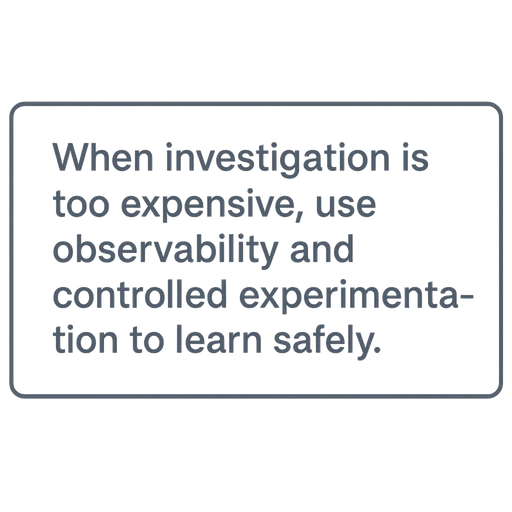
Monitoring and Observability
Freshness, completeness, and accuracy metrics
Pipeline success trends
Output anomaly detection
Safe Deployment
Canary and shadow pipelines
Automated rollback
Feature branches with extended monitoring
Confidence Through Comparison
Run new and old transformations in parallel
Compare outputs for a week
Let production data reveal truth faster than speculation
Part 5: The Organizational Challenge
Why Technical Solutions Aren’t Enough
Most data debt is cultural, not technical.
Teams lack:
Time allocated for investigation
Permission to delete old code
Accountability for documentation
Ownership of pipeline lifecycle
“Just ship it” pressure creates shortcuts, and shortcuts create debt.
Making Debt Visible to Leadership
Executives won’t fund what they can’t see.
Use metrics that translate engineering drag into business impact:
Percentage of undocumented transformations
Average time to implement new features
Number of data incidents per quarter
Opportunity cost in delayed initiatives
When leaders can visualize degradation, they allocate resources to fix it.
Building Paydown Into Velocity
Separate “tech debt sprints” rarely survive reprioritization.
Instead:
Make every feature story include “What debt are we creating or reducing?”
Normalize investigation as legitimate engineering work
Celebrate debt reduction as productivity, not overhead
Ownership and Accountability
Data products need owners, not passive maintainers.
Owners are responsible for:
Documentation
Quality
Evolution
Escalation paths when logic is unclear
Knowledge management becomes a first-class engineering function.
Part 6: The Contrarian Take
Not All Technical Debt Is Bad
Sometimes, debt is strategic:
Proving a business case quickly
Hard-coding for a one-time campaign
Accelerating delivery where speed outweighs risk
The key is intentionality - consciously taking on debt with an explicit plan to pay it back.
Good Debt Is Documented Debt.
Record why it exists
Define when it should be resolved
Track it in the registry
The real enemy isn’t debt itself - it’s untracked, unintentional, compounding debt.
Conclusion: A Path Forward
Start Small, Think Big
Week 1
Create a transformation registry
Identify five highest-value data products
Begin documenting new transformations
Month 1
Add tests to critical pipelines
Implement lineage tracking
Time-box investigation sessions
Quarter 1
Ring-fence core data products with contracts and monitoring
Enforce “no undocumented transformation” as a standard
Integrate debt paydown into sprint planning
The Long Game
Shift culture from ship fast to ship sustainably.
Recognize investigation as real engineering work.
Celebrate debt reduction as an innovation enabler.
Teams that manage data debt effectively:
Move faster by moving confidently
Innovate more because their foundations are solid
Scale safely with predictable outcomes
Retain talent because engineers spend time building, not excavating
Everyone has data platform debt. The differentiator is knowing:
What debt exists
Why it exists
What it’s costing you
Start answering that question today.
Call to Action
Audit one critical pipeline this week -what don’t you understand about it?
Start a transformation registry.
Add one test documenting the why behind a transformation.
Discuss investigation time in your next sprint planning meeting.
Share this with your team and map where your debt is hiding.
The best time to address data platform technical debt was two years ago.
The second best time is now.